
Last month, I wrote a blog post, “Gen AI & Coding Interactive Activities“. I gave three different examples of things that I was trying with Gemini to code for me. Then it dawned on me this week that Canva Code now allows users to copy html code from a prompt in Canva. When Canva Code first came out, this was not available. Now that it is, users are able to copy the code and then provide the interactive activity on a platform other than Canva, such as Google Sites. (One thing that I do like about Canva Code is the ability to hit the use in a design button and choose between what type of file it should live in, within Canva. You can choose Canva website, presentation, doc or whiteboard. However there are times where I think that being able to copy the code and place it on a different platform can be beneficial).
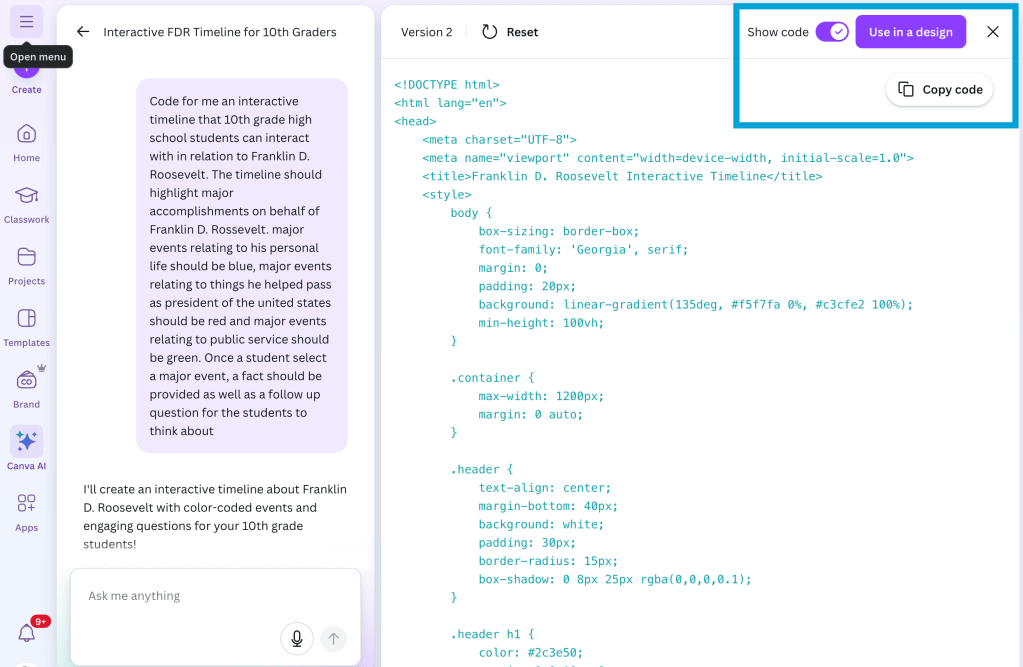
What I decided to do was to take two of the prompts from the previous blog post, the FDR timeline and the Family Feud activity, and put them into Canva Code. I then copied the code for each of them and embedded the interactive activity on the google site that already had Google Gemini’s version of the activity. You can view the sample timeline HERE and the Family Feud activity HERE.
This can be a great learning opportunity for students and teachers. As long as the prompt is exactly the same (I can’t promise mine is 100% the same but it is really close), it could be a great opportunity for students to learn that not all LLM’s are treated or designed the same. I also think it speaks to how working with one model might be good for one reason, but maybe realize not as good for a different reason. Just some food for thought.
For instance, I like how Canva AI interpreted the timeline in a vertical format, rather than how Gemini built it horizontally. I found it interesting that Canva AI used emojis with its timeline whereas Gemini did not. When you look at the Family Feud activity, they are both designed differently with different colors as well as with the organization of work flow of awarding points. Those are just a couple of examples of how even though the prompts are the same (or almost exactly the same), the LLM interpreted the result differently.
This then connects with the idea of if humans are going to work with genAI, they really need to be able to think critically with the tool. Humans need to be thinking about the output. The thinking needs to go beyond is the information right. Humans need to think about, was this information expected, is it organized correctly, is it telling the right story, etc. Critically thinking is important.
And that is my Spiel…
 Craig M Sheil