Google Classroom Consistency

Our district, grades 3-12, decided to give a fresh look to Google Classroom. This year our district is working towards streamlining how homework and tasks for students are reported. This came from a district homework committee, that was put together over a year ago, analyzing how and what teachers are reporting as work needing to be accomplished. The committee discovered that there was absolutely no consistency. It was determined that from this committee, all teachers, especially grades 5 – 12, would report homework through Google Classroom.

Many students and teachers were unaware of the fact that Google Classroom helps organize the learner automatically for them whether it’s using the calendar mode to view assignments or the to-do list mode to see what has been completed or not completed. In the to-do list, there is also a missing column letting students know exactly what they are missing from all of their classes. Students also are able to see what assignments has to be done right on the main page of Google classroom in the classroom tiles or from the chrome device itself by clicking on the date and seeing right away what assignments are due very soon without even needing to be on the Google Classroom page in chrome.

One big change for this year is asking teachers to report work that students need to complete in Google classroom whether it is a digital assignment or not. This was something really new, especially at the high school level, as a teacher may not necessarily have assigned non-digital work through Google classroom because there wasn’t something to turn in online. As a result, we’ve had conversations with students about how they need to honestly use the “Mark as Done” button when it is something that isn’t physically being turned in. We also took this opportunity to remind students to create files right from the assignment itself if a teacher isn’t pushing an actual template to the students. By encouraging them to create the file right inside the assignment, not only will Google Classroom name the file for them, it will also keep the file organized. On the teacher’s side, this also allows the teacher to see student work right away and not have to wait until the assignment is physically turned in to see how and what the student is doing throughout the writing or creating process.

We’ve also taken the opportunity to send invites to guardians letting them know they have the opportunity to receive Google classroom guardian summaries weekly, or daily. These summaries let the guardian know what their child has or has not been completing as well as upcoming assignments that they have in their classes. Not only is this a great tool,  it’s automatically doing the work for the teacher of communicating to parents, if they want that communication. We took this opportunity to let teachers know what access parents/guardians would have now that parents/guardians can click on a link in the Guardian Summaries email and get ‘view only’ access to the classworks page of the Google Classroom.

In order to make this all work, we had to thoughtfully think about how we were going to educate all parties involved. We’ve had to educate administrators and what things would look like. We’ve given reminders to teachers who utilize Google classroom on a day-to-day basis…things that they should consider or maybe new techniques or approaches to use this year. We’ve reminded students five ways in which they can be notified what tasks or homework assignments they have to complete and determine which approach works best for them and their learning styles. Lastly, we’ve educated the community of what guardian summaries are all about, what they have access to and not have access to, and provided resources on our district tech website to help guide guardians and or students. The Digital Learning Specialist Team has curated resources on our district technology site to help parents/guardians and students. Click HERE to view. On the teacher side, we have provided resources in our in house google classroom that provides many best practices and how to’s with Google Classroom.

We still have a lot of work to do, but I am very proud of the work everyone has accomplished thus far.

And that is my Spiel…
Part 2: GenAI & Coding Interactive Activities (Comparison of Tools)

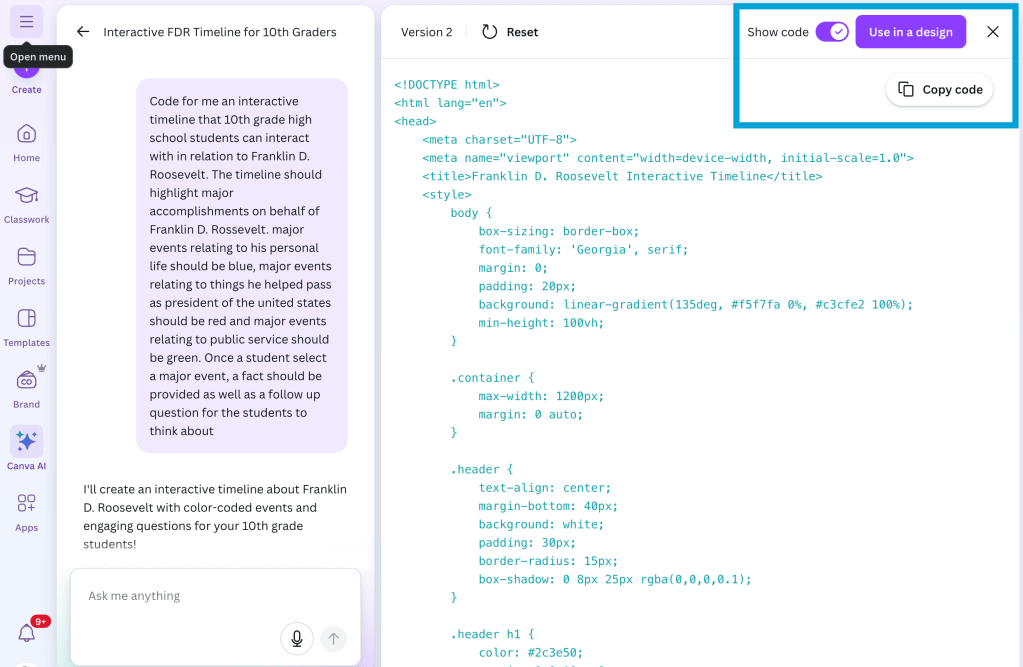
Last month, I wrote a blog post, “Gen AI & Coding Interactive Activities“. I gave three different examples of things that I was trying with Gemini to code for me. Then it dawned on me this week that Canva Code now allows users to copy html code from a prompt in Canva. When Canva Code first came out, this was not available. Now that it is, users are able to copy the code and then provide the interactive activity on a platform other than Canva, such as Google Sites. (One thing that I do like about Canva Code is the ability to hit the use in a design button and choose between what type of file it should live in, within Canva. You can choose Canva website, presentation, doc or whiteboard. However there are times where I think that being able to copy the code and place it on a different platform can be beneficial).

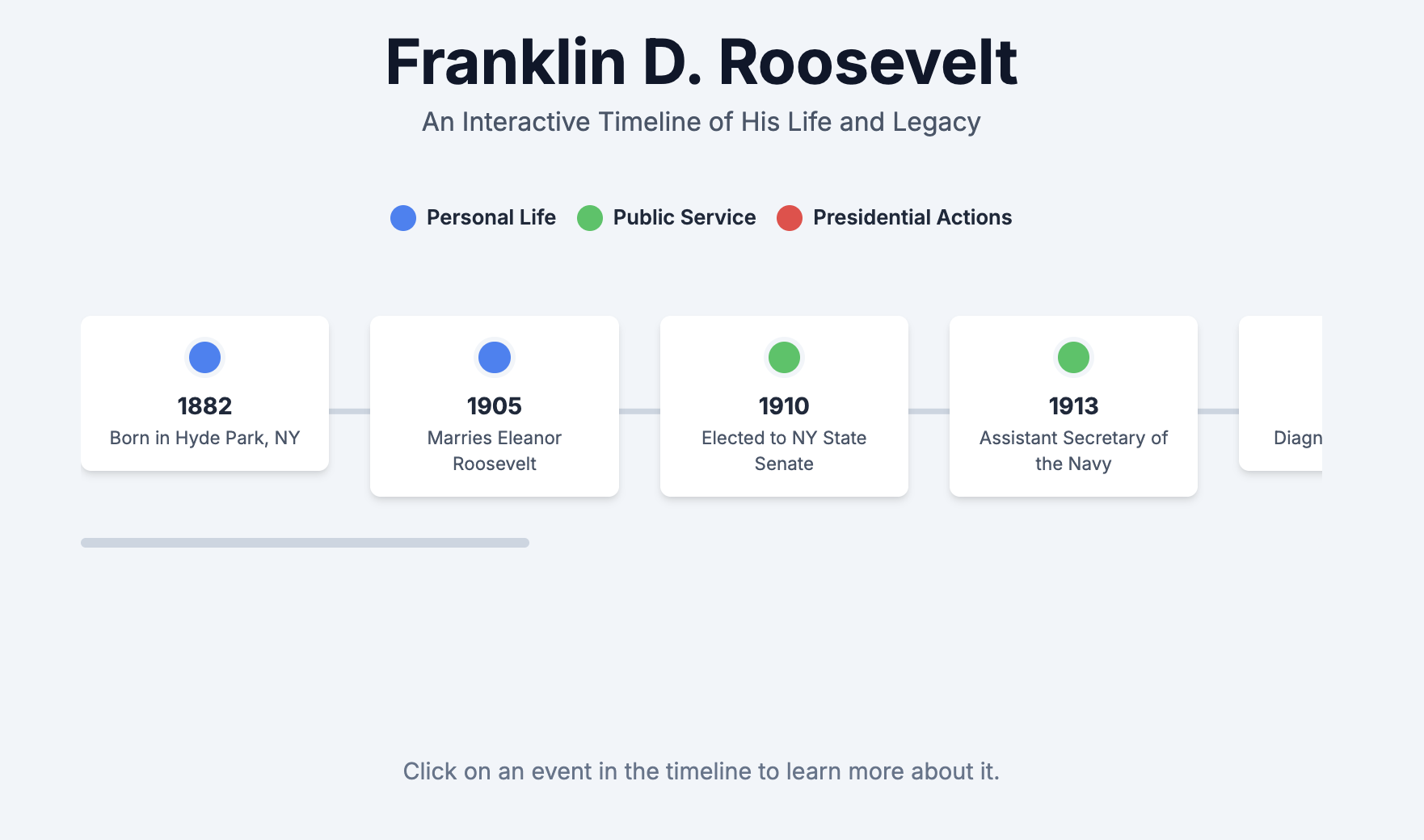
What I decided to do was to take two of the prompts from the previous blog post, the FDR timeline and the Family Feud activity, and put them into Canva Code. I then copied the code for each of them and embedded the interactive activity on the google site that already had Google Gemini’s version of the activity. You can view the sample timeline HERE and the Family Feud activity HERE.

This can be a great learning opportunity for students and teachers. As long as the prompt is exactly the same (I can’t promise mine is 100% the same but it is really close), it could be a great opportunity for students to learn that not all LLM’s are treated or designed the same. I also think it speaks to how working with one model might be good for one reason, but maybe realize not as good for a different reason. Just some food for thought.

For instance, I like how Canva AI interpreted the timeline in a vertical format, rather than how Gemini built it horizontally. I found it interesting that Canva AI used emojis with its timeline whereas Gemini did not. When you look at the Family Feud activity, they are both designed differently with different colors as well as with the organization of work flow of awarding points. Those are just a couple of examples of how even though the prompts are the same (or almost exactly the same), the LLM interpreted the result differently.

This then connects with the idea of if humans are going to work with genAI, they really need to be able to think critically with the tool. Humans need to be thinking about the output. The thinking needs to go beyond is the information right. Humans need to think about, was this information expected, is it organized correctly, is it telling the right story, etc. Critically thinking is important.

And that is my Spiel…

Gen AI & Coding Interactive Activities

This past summer, I had the opportunity to attend a Google Symposium in Chicago. Over the span of the three days, we had an opportunity to learn about what Google is working on, provide some feedback on some future projects, get inspired from one another, and continue to grow our professional learning network. One component that really resonated with me was the capabilities of Google Gemini. While I knew that I could ask Gemini to help assist with many different tasks, one thing that I hadn’t explored was how Gemini can help code an idea or an activity. 

A lightbulb moment happened for me when Andy Caffrey highlighted how he used Gemini to code an interactive activity that we participate in. We walked through the steps that I’m about to walk through with you as to how you can take your idea and ask Gemini to assist in making that idea turn into a reality. Gemini will write some code, you have the ability to preview the activity to see if what was coded is what you were expecting, and then you copy that code and paste in a Google Site. Light bulb moment for me. Over the past couple weeks, I’ve explored around with different ideas, techniques and activities and I hope these ideas will inspire you to think about what you could possibly have Gemini help you out. (Keep in mind that while I am highlighting how Gemini can code, you can do similar tasks in Canva using Canva AI to code interactive activities.)

To view all three examples on a Google Site, click HERE

Coding a Timeline

There is a classroom in the high school that has a big timeline of the content that students are learning in their class. It spans from wall to wall. I got to thinking that perhaps we can turn that information into an interactive timeline. I asked Gemini to create an interactive timeline about Franklin D Roosevelt, and the accomplishments that he helped institute from his presidency. Below is an example prompt that I put into Gemini. You can see that I wanted this to be a timeline beyond just students scrolling and seeing different components of FDR. I asked Gemini to design it so that if they actually selected a particular highlight in that timeline they would actually be prompted to answer some questions. I wanted immediate feedback when answer questions as well as providing a food for thought question for them to think about.

“Code for me an interactive timeline that 10th grade high school students can interact with in relation to Franklin D. Roosevelt. The timeline should highlight major accomplishments on behalf of Franklin D. Rossevelt. major events relating to his personal life should be blue, major events relating to things he helped pass as president of the united states should be red and major events relating to public service should be green. Once a student select a major event, a fact should be provided as well as a follow up question for the students to think about.” – prompt with Google Gemini – September 24, 2025

To view the example on a Google Site, click HERE

Self Checker Activity – Interactive Charts

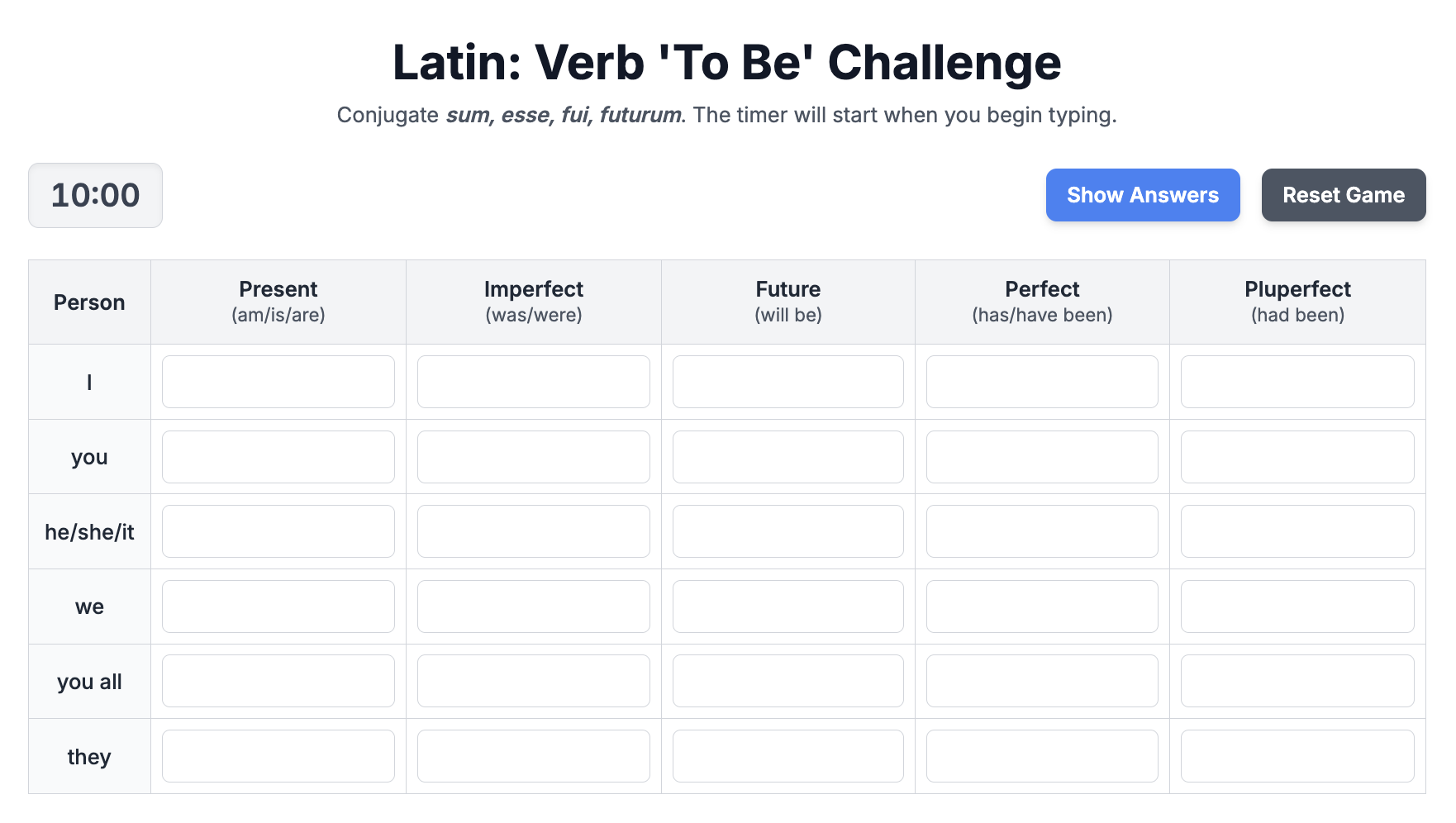
The next activity – Latin teachers wanting to be able to have student self check their work. With the help of uploading a PDF file of a chart, we were able to ask Gemini to create an activity where the moment the student starts entering in answers, the timer starts ticking and students are able to self check their work. This can be an alternative to a Kahoot!, Gimkit, or Blooket game. The idea down the road would be for this latin teacher to have a google site that contains all of these self checkers for students for each of the chapters in the class. A one stop shop. Below is a sample prompt that was put into Gemini.

“Code interactive tables on verb to be chart using the information provided in the pdf document. You will ask students to complete the table on verb to be under the present-am/is/are, imperfect-was/were, future-will be, perfect-was/werehas/have been and pluperfect-had been columns. Students will enter the information into the table cells. If they get it right, fill in the box green. Provide a count down timer from 10 minutes once they start. Provide a ‘show answers’ button to show answers as well as a reset game button to reset the game” – prompt with Google Gemini – September 12, 2025

To view the example on a Google Site, click HERE

‘Family Feud’ – Fun Advisory Activity

A third example pertains to a fun advisory game that advisors can play with their advisees. Our principal sent out a form that I put together asking staff to answer three questions. The three questions were:

What is one question you hear students ask you every day?

What is one thing that gets you through the day?

What’s the first thing you look forward to on summer vacation?

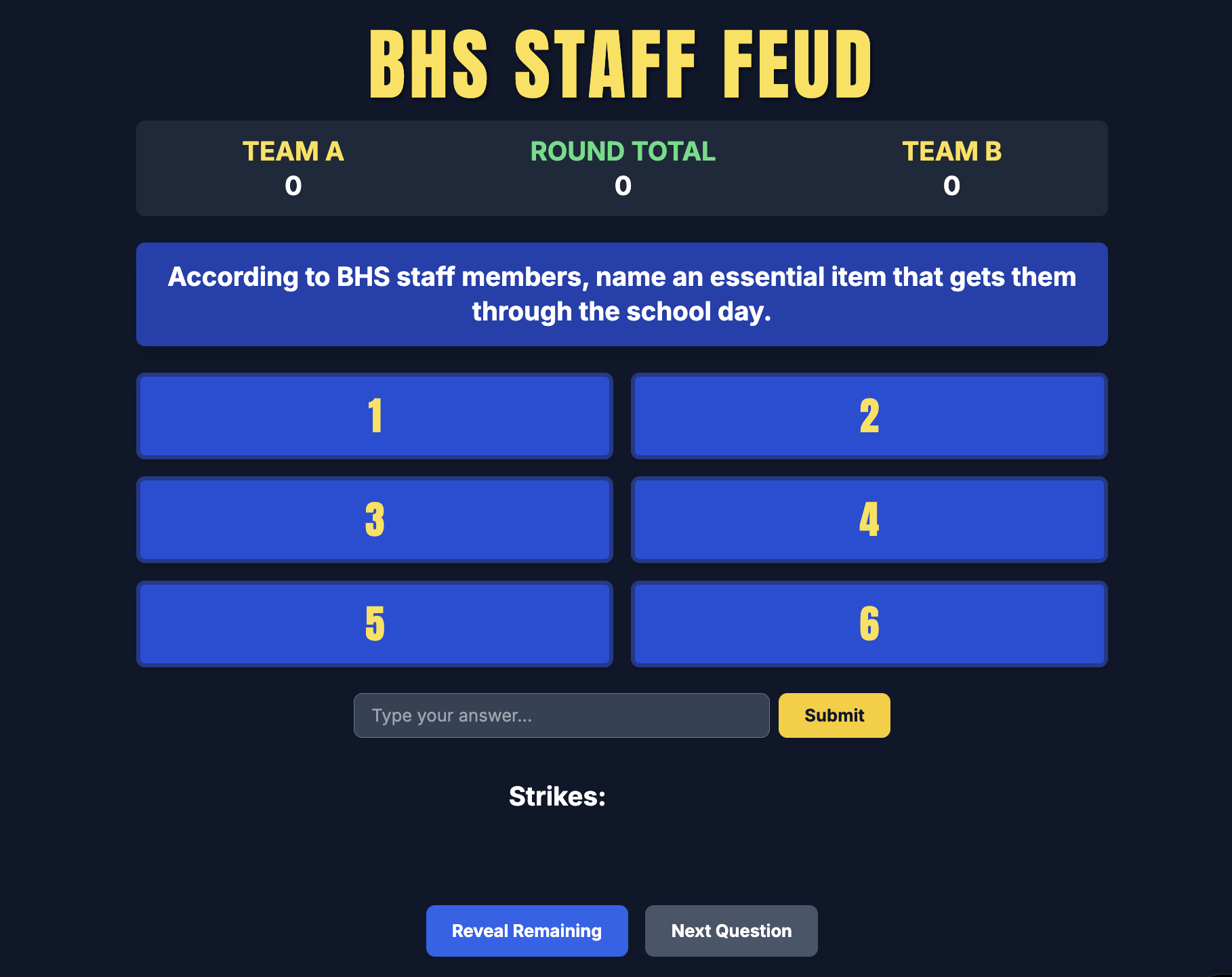
From those results, I asked Gemini to create a Family Feud style game. The idea is to then have advisories play the game to either compete against their own peers in advisory or against another advisory – but the topic is about their own teachers and their responses. Below is a sample prompt that was put into Gemini

“code a family feud game where 53 BHS staff members were surveyed with the top 6 answers on the board. there are three rounds of questions. The first question is “According to BHS staff members, name an essential item that gets them through the school day” The top six answers with the number of staff who said that answer are: Coffee – 19; Water – 9; Laptop – 4; Snacks – 3; Colleagues – 3; Music – 2. The second question for round two is “According to BHS staff members, name something that staff look forward to doing on the very first day of summer vacation” The top six answers are: Sleeping in – 25; Coffee – 6; beach – 3; Going for a walk – 2; gardening – 2; hiking – 2. The third question for round three is “Name a question that BHS staff hear from their students almost every single day”. The top six answers are: Is this graded? – 15; What time is it? – 6; What are we doing today? – 4; Can I go to the bathroom? – 3; Do you have a charger? – 3; Can we leave early today? when a student types in a response, if they have an answer, the answer reveals behind its spot with the number associated with it. If an answer is wrong, put a red x. Student is only allowed 3 red x’s before the other team gets to steal. if the team gets three strikes, allow one more guess to see if the other team gets an answer so that they can steal the points. Then provide a button to indicate which team should get the points. Then allow a reveal remaining button to show so see the remaining answers that were not figured out. Then allow users to go to the next question.” – prompt with Google Gemini – September 25, 2025

To view the example on a Google Site, click HERE

Three completely different examples…three completely different purposes, but I like how I’m able to take an idea that a teacher or myself might have and try and make it become reality with the assistance of Gemini. 

Workflow

In terms of workflow, these are the steps that you would use to help make something become a reality 

  • Come up with an idea 
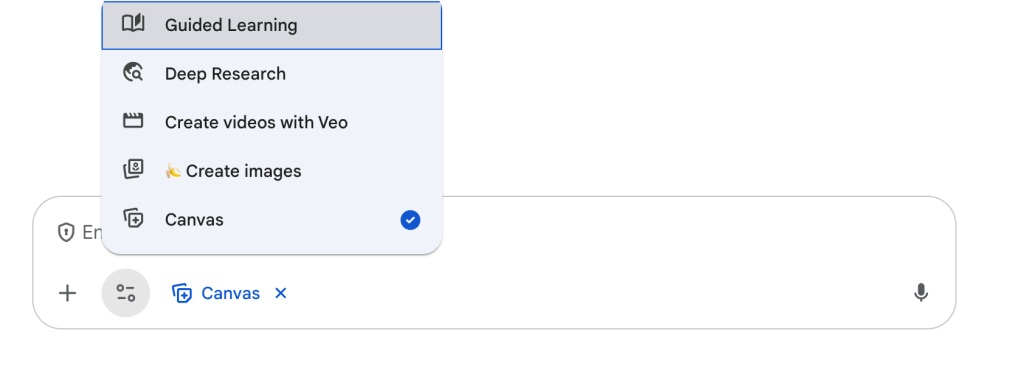
  • Open up Gemini and put in your prompt – make sure you have selected Canvas under the tool menu. Remember to be as specific as possible to help ensure that you will get a product that you’re looking. Don’t be surprised if you have to continue the conversation and go through several different versions. 
  • Preview your coded activity that Gemini has provided you.
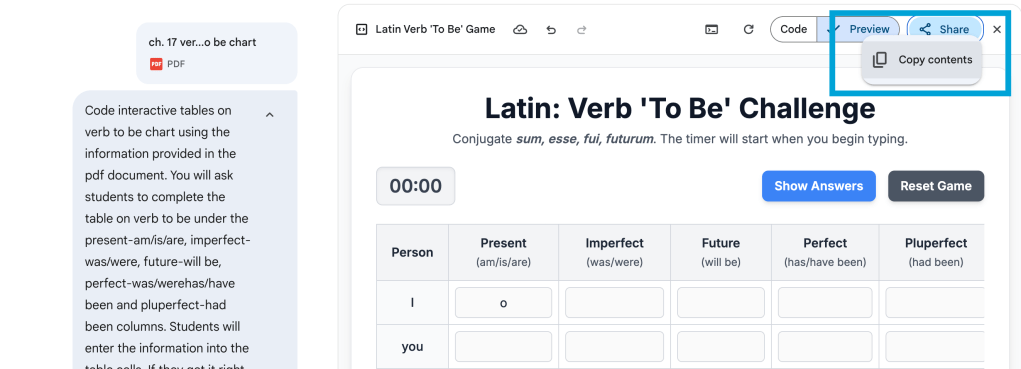
  • Copy the html code from the share button on the top right corner
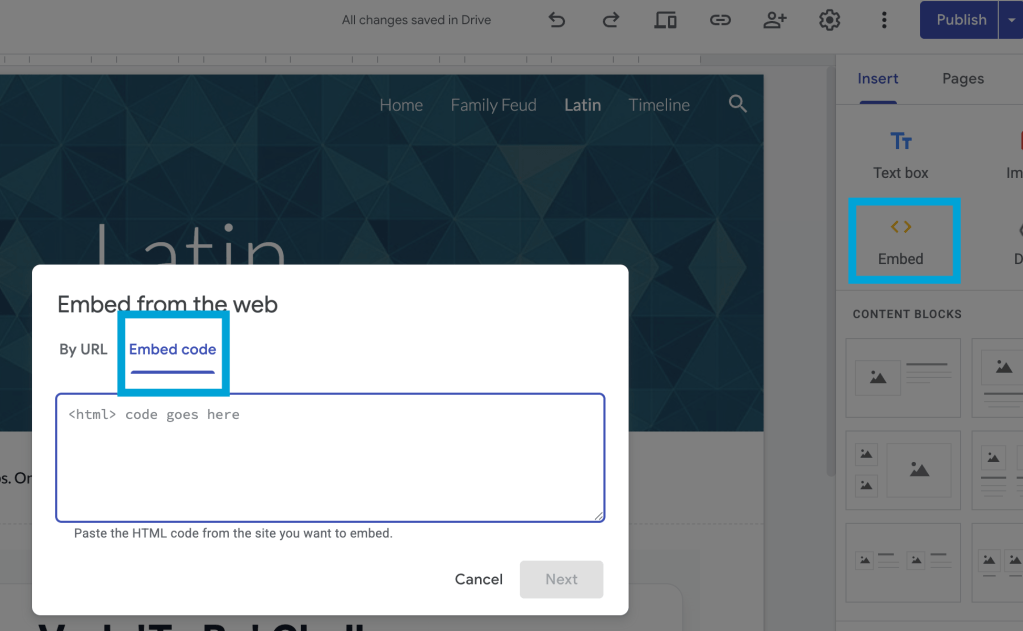
  • Go to Google sites – as an editor, go to the top right corner and select the embed button, and paste your code
  • Once you are happy with your page on your site, don’t forget to publish or republish your website for others to view.

What ideas have you asked Gemini? What will you ask Gemini to do for you? If you have any questions feel free to reach out.

And that is my Spiel…

Goodbye 3 Inch Binders

This year I’m hitting a 15th year anniversary of being in the same role at the same school. Prior to this position, I taught high school mathematics for eight years. I actually taught almost every high school math course that there could be offered. When I made the transition to be becoming a Digital Learning Specialist, I saved every 3 inch binder full of materials, notes, and assessments for each class.

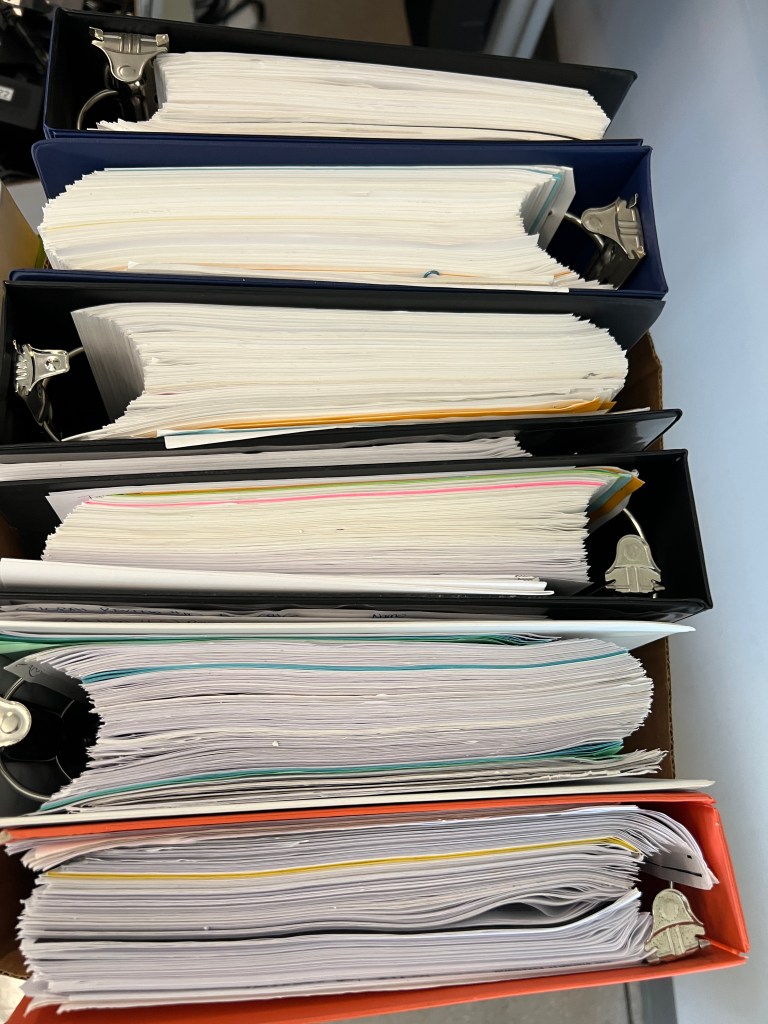
After 10 years, I slowly got rid of a few of those binders, but still managed to keep ten 3 inch binders. These binders consisted of two of my favorite courses, Algebra II Honors and Calculus. Algebra II Honors was that class that I just loved to teach. I love the content in it. I kept Calculus for a couple reasons – I appreciated the challenge that it gave me and in many instances, I had to spend hours upon hours upon hours, relearning calculus myself. I worked through and solved all of the problems that I was assigning my students. You just can’t wing it when teaching Calculus. As a result of this, the thought of just getting rid of that content due to the amount of hours I spent was very hard for me. Plus, there was always this idea in the back of my mind that well what if I do go back into the math classroom?

Seeing as though I’ve now hit year 15 of not teaching math, I think I can safely say I’m probably not gonna go back to the math classroom. But seeing these binders also made me think about how things have drastically changed over that time span. Everything that was done was done by paper and pencil/pen. Yes there was technology but it was not as easily accessible, especially in the world of mathematics. 15 years ago, not every teacher had their own laptop given to them. I can remember many of days where I was physically cutting paper and pasting those individually cut out problems and pasting them onto a sheet of paper to create an activity to be photocopied. All those hand written worksheets and activities that students received from me as well. That is mostly a thing in the past!

I also got to thinking that these binders are a physical representation of the hard work I spent into designing and running curriculum. Nowadays, all of that content is just hidden inside of our Google Drive in many different folders (or for some, not folders at all). I can only imagine how many folders that actually exist inside of my drive with the amount of files in each of those sub folders. Having things digitally just makes it a bit harder for us to actually visualize and understand the amount of work and dedication that’s been put into the curriculum that we teach each and every year. Seeing something physical makes it a lot easier to see the hard work and dedication.

I really did hate getting rid of these binders, but I have come to realize that

  • the curriculum in the binders would not be taught the same way that it was taught 15 years ago
  • I haven’t looked at it in 15 years and probably won’t ever again
  • these physical binders are no different then the digital folders I created 13 years ago that I have not looked at

Yes it was hard to throw away, but also a sense of peace as well. I know that this is not a normal type of post that I share on my blog, but felt it was important to reflect.

And that is my spiel…

Something About In Person Trainings

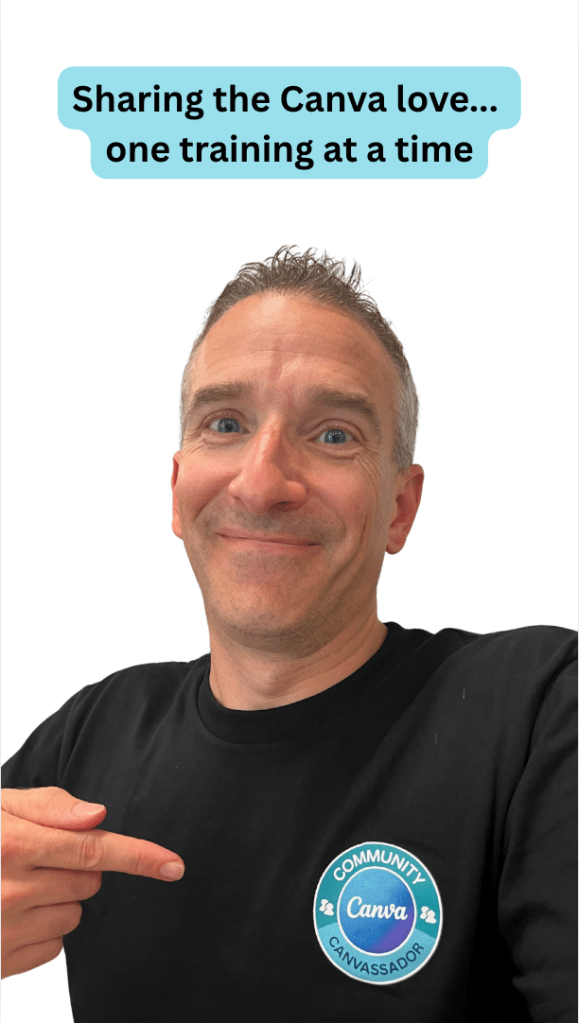
Earlier this week, I had to opportunity to deliver a one day in person training on “Unlocking the Potential with Canva Education” to educators and professionals from New Hampshire and Massachusetts. I put my Canvassador shirt on and shared my Canva love to others…and I had a great time.

As with many folks over the past 5 years, many of the trainings that I have delivered or participated in have been virtual. Even my graduate level courses that I teach or co-teach have all moved to a hybrid online model. This week has reminded me how fun it is to do things in person. It allows you to build a connection with others and get to know one another – even though it might only be for six hours. It easily allows participants to talk with one another and to give ideas or suggestions without having to be wait to be called on. Participants are able to experience the energy from on another. It also allows for differentiation and an opportunity for folks to be able to work on their own projects/ideas while still being able to ask questions as I walk around.

Sure, it is so much easier to click a button for a webinar or training and tell yourself, I can put it on and play it in the background while I do (fill in the blank). Or sure, I will sign up for the webinar or training and if I don’t go to it, I’ll just get the recording to watch on my own time, if ever. But…I was reminded of how fun it really is to do trainings together in one space. The energy in the room and the laughter in the room can’t be matched.

Quick Overview of the Day

The day was all about Canva Education. A Sandbox Canva presentation was shared out to the participants so that they could explore around with the features that I was modeling on each of the slides. We talked about

  • things you should consider when designing your own content
  • how to get inspired from designs from others
  • how to use templates from others
  • how to share out one’s own files
  • Canva’s AI capabilities
  • how one can demonstrate knowledge with the record feature both video and audio (thrilled to see the enhanced feature of voice recorder)
  • how to deal with organization of files
  • how to work with bulk create (like a mail merge)
  • and on and on…

There was also an opportunity for participants to work through a design/task/project of their own during open lab time where I would walk around and help assist with questions.

A nice added touch was the fact that Canva Education provided some swag for participants (pens and stickers) and well as paid for the food for lunch. Thankful for their willingness to support the event. I created a canva video highlighting the day for anyone interested.

I look forward to the next in person opportunity….

And that is my #Spiel